
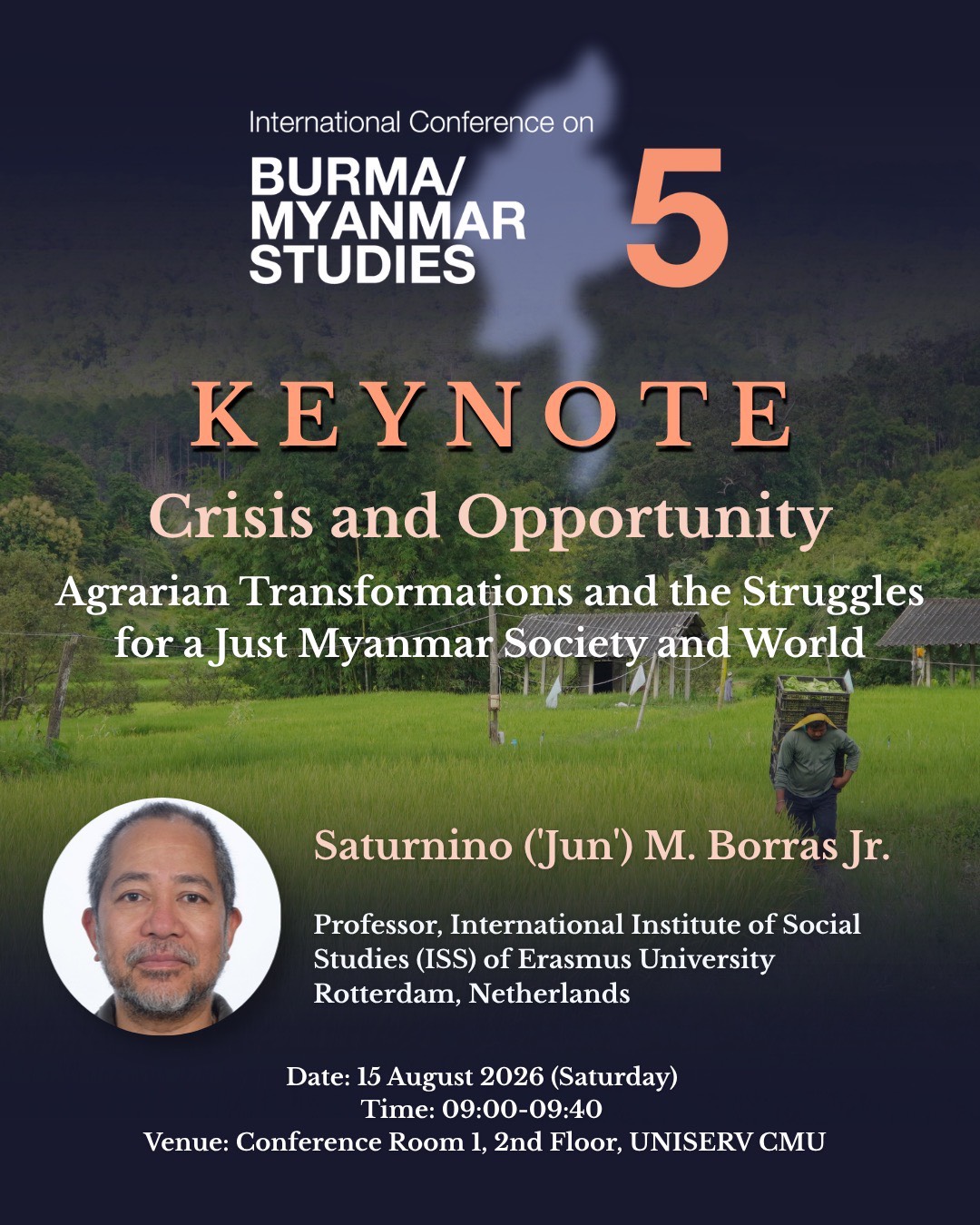
The ICBMS5 committee is happy to announce our conference’s keynote speaker, Saturnino (‘Jun’) M. Borras Jr., Professor, International Institute of Social Studies (ISS) of Erasmus University Rotterdam, Netherlands. His keynote address will be “Crisis and Opportunity: Agrarian Transformations and the Struggles for a Just Myanmar Society and World.” This keynote address will be held Saturday, 15 August 2026, from 9:00-9:40 am at Conference Room 1, 2nd Floor, UNISERV.
Jun Borras is a Professor of Agrarian Studies at the International Institute of Social Studies (ISS), Erasmus University Rotterdam, and a member of the Erasmus Professors program for positive societal impact. Originally from the Philippines and based in the Netherlands, he specializes in land politics, social movements, scholar-activism, and climate change.
He served as Editor-in-Chief of the Journal of Peasant Studies for 15 years (until 2023) and was a Canada Research Chair at Saint Mary’s University. Borras is an associate at the Transnational Institute (TNI) and actively collaborates with global social movements, including La Via Campesina, CASAS, and Myanmar activist organizations.
A recipient of a European Research Council (ERC) Advanced Grant (2019–2025) on global land rushes, he is also co-PI on an ERC Synergy Grant (2026–2031) examining landscape reform in the Anthropocene. He has co-authored and edited several foundational works on land politics published by Oxford and Cambridge University Press.
Professor Borras’ talk will take the global food system and agrarian transformations as the entry point for talking about broader systemic issues in the context of crisis and opportunity for an emancipatory politics. The interconnections between global political economy and Myanmar will be the focus of the analysis. The talk will look into the intersectional struggles for a just, fairer and kinder world and Myanmar society, engaging with topics related to political struggles for social change, in part inspired by Nancy Fraser’s critique of environmental justice struggles as ‘merely environmental’, exploring similar notions such as ‘merely agrarian’ struggles. The idea is to explore possibilities for building broader intersectional fronts of struggles across different forms and levels, in social justice struggles globally and in Myanmar. Throughout the talk, the role of scholar-activism will serve as the key underlying thread.