
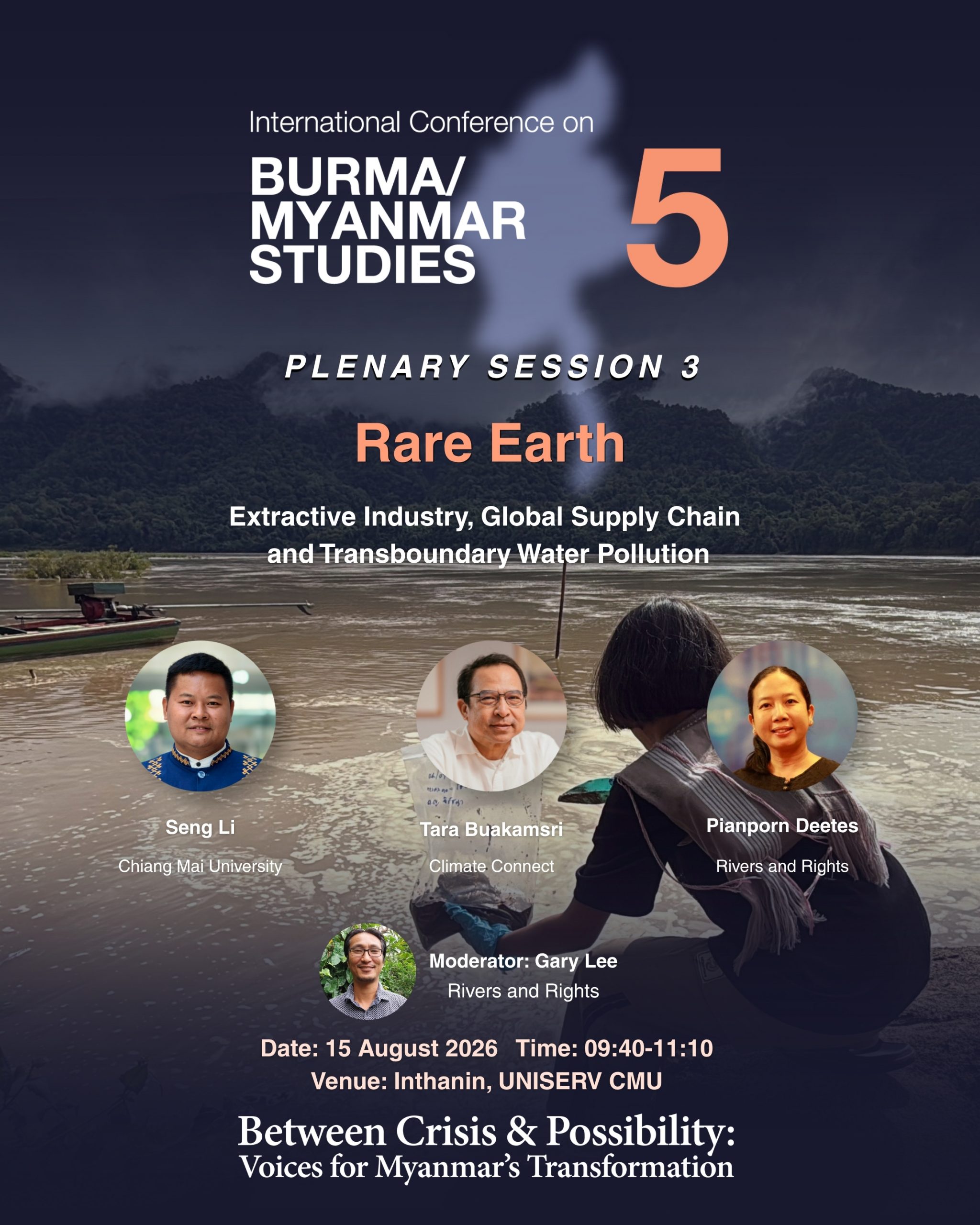
The third plenary session of ICBMS is “Rare Earth: Extractive Industry, Global Supply Chain and Transboundary Water Pollution,” on Saturday 15 August from 9:40 to 11:10 am in Conference Room 4.
Myanmar has become a major source of heavy rare earths, particularly in Kachin State along the Chinese border. Mining in northern Myanmar is estimated to supply roughly half of the world’s heavy rare earths, which are essential for electric vehicles, wind turbines, and other high-tech industries. China dominates the processing and manufacturing of these minerals, giving it significant influence over the global supply chain. While much of the processing and economic value is captured in China, the environmental costs are largely borne by communities in Myanmar, where rare earth mining has been linked to chemical leaching, water contamination, and damage to forests and rivers.
The session brings together different perspectives on the expansion of rare earth mining and related questions of resource governance, conflict, and environmental degradation. It examines changes in territorial control during armed conflict, their impact on extractive industries, and the links between Myanmar’s rare earth sector, global supply chains, the clean energy transition, transboundary environmental impacts, human rights, and regional accountability.
Seng Li, Research Fellow at RCSD, Chiang Mai University, examines how changes in territorial control from the Border Guard Force (BGF) to the KIO/A have reshaped the governance of rare earth mining in northern Kachin State, including taxation, regulation, environmental protection, labour rights, and cross-border trade, highlighting persistent governance gaps and challenges for local communities.
Tara Buakamsri, Strategy Director at Climate Connectors, explores Myanmar’s role in China’s heavy rare earth supply chain and its significance for the global clean energy transition, focusing on the environmental and political costs, as well as the potential and limitations of traceability, international regulation, and corporate accountability.
Pianporn Deetes, Executive Director and Co-founder of Rivers and Rights, examines the transboundary impacts of rare earth mining on rivers, ecosystems, and downstream communities in Myanmar and neighbouring countries. Drawing on recent pollution emergencies in the Kok, Sai, Mekong, Salween, and Kraburi river basins, the panelist connects environmental degradation with human rights and explores how regional cooperation and accountability can better protect communities and shared river systems.