
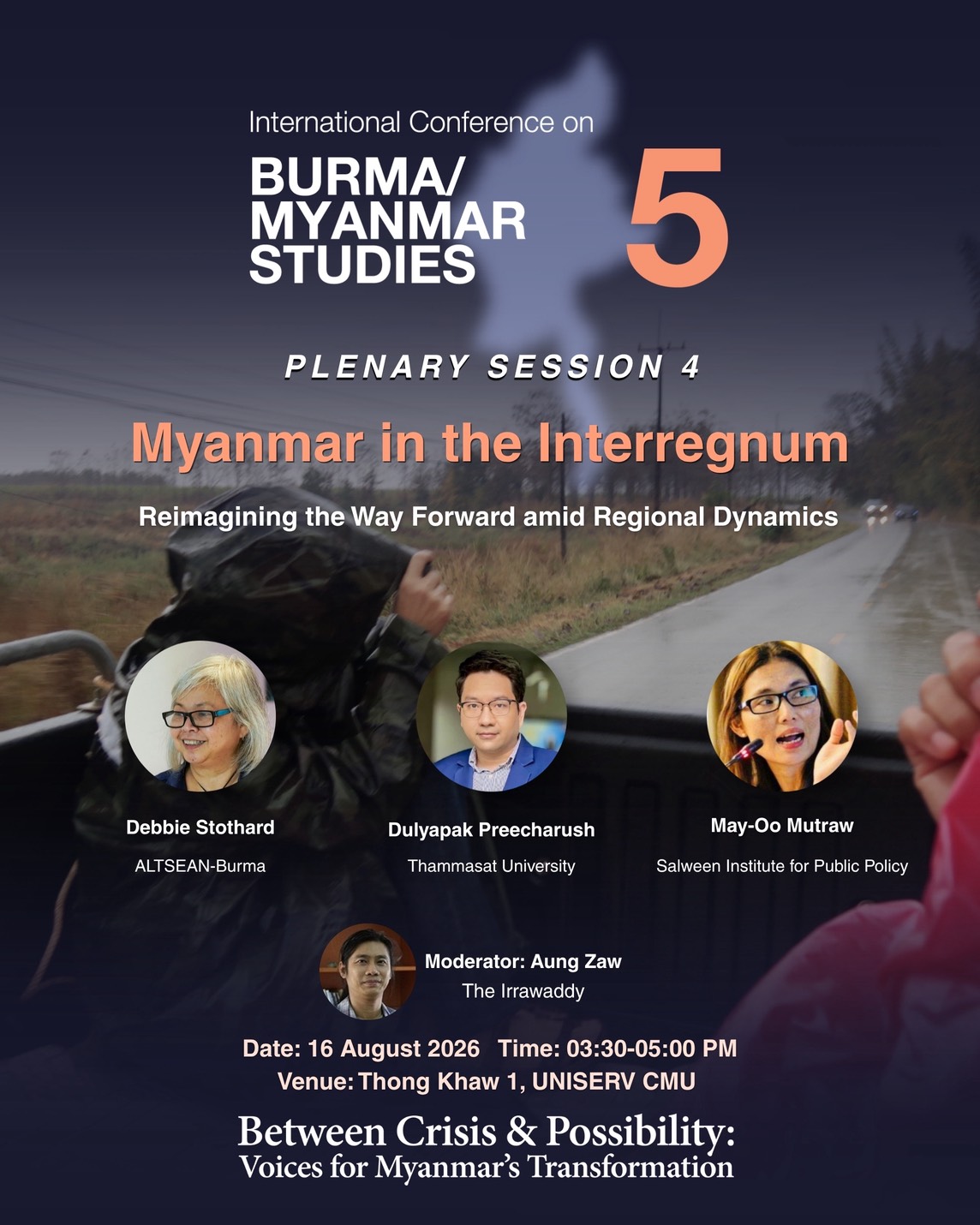
Plenary session 4 of ICBMS5, “Myanmar in the Interregnum: Reimagining the Way Forward amid Regional Dynamics” is happening Sunday, 16 August from 15:30 to 17:00 in conference room 1 & 2, 2F of Uniserv.
Myanmar is in an interregnum in which the political order established before the 2021 military coup has been profoundly disrupted, while no agreed alternative political settlement has yet emerged. More than five years after the coup, the SAC faces deep challenges to its domestic legitimacy and growing military pressure from resistance forces, while its attempts to regain political and international legitimacy have included military-controlled elections and diplomatic engagement. At the regional level, neighbouring states and ASEAN members continue to balance different approaches to the junta, the resistance, and the broader conflict, with priorities such as border security, economic interests, and regional stability often taking precedence over meaningful political change and humanitarian concerns.
The session brings together different approaches to Myanmar’s political transition and the challenges of reimagining a way forward amid continuing conflict and shifting regional dynamics. It examines questions of political legitimacy, state structure, constitutional transition, and the role of neighbouring states and regional institutions in shaping Myanmar’s political future. The session will consider the institutional and political conditions that may be necessary to move beyond the current impasse and support a more sustainable transition.
Debbie Stothard, Founder and Coordinator of ALTSEAN-Burma, brings a perspective on Myanmar’s current political crisis and the challenges surrounding the country’s search for a viable political future.
Dulyapak Preecharush, Associate Professor at the Faculty of Liberal Arts, Thammasat University, examines state structure in Myanmar’s post-coup politics, contributing to broader questions about political authority, institutional transformation, and the future organisation of the state.
May-Oo Mutraw, Senior Policy Advisor at the Salween Institute for Public Policy, examines Burma’s constitutional crisis, regional dynamics and the differing strategic interests of neighboring states and ASEAN, as well as the lack of an institutional framework linking the two. A transition architecture is proposed that can connect domestic constitutional transformation with regional concerns and provide a basis for a sustainable political transition.