
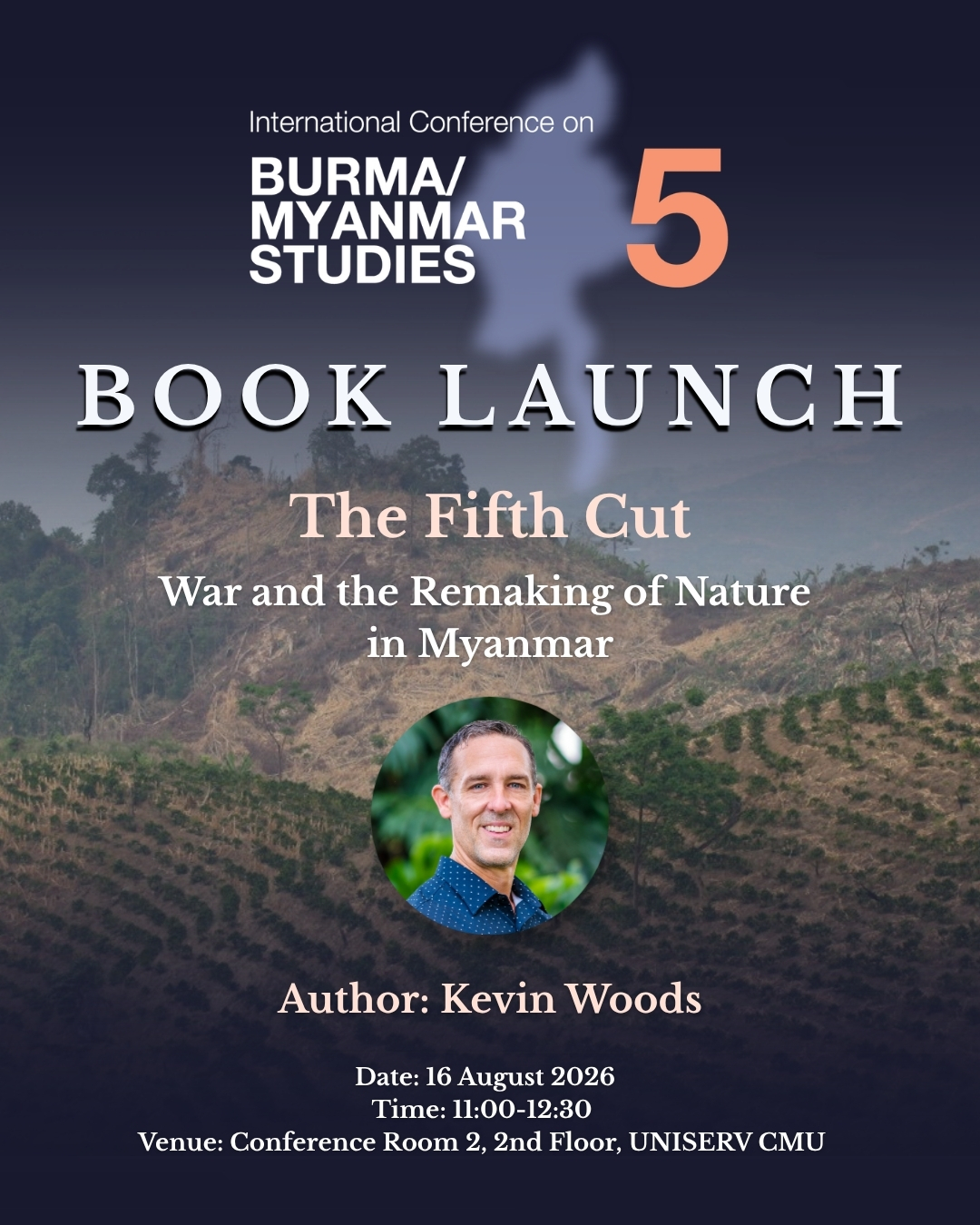
ICBMS5 is please to host the launch for Kevin Woods’ new book, “The Fifth Cut: War and the Remaking of Nature in Myanmar,” on Sunday, 16 August from 11 am to 12:30 pm in room 2.
While scholars have extensively analyzed the military, political, and economic dimensions of Myanmar’s civil war, the role of environmental transformation in mediating both revolution and the state’s efforts to countering it remains largely unexamined. This book addresses that gap through a political ecology of war framework, drawing on two decades of collaborative research in Myanmar’s revolutionary ethnic territories along the borderlands with China and Thailand. The book’s central argument is that market-mediated landscape change — logging, agribusiness concessions, smallholder cash cropping, state forest conservation — functions as a political technology that counters revolution. During the Cold War, Myanmar’s military implemented a “Four Cuts” strategy to sever revolutionaries’ access to food, funds, intelligence, and recruits. Since the 1990s, the military state has supplemented these tactics with large-scale development interventions that transform the highland forests where ethnic communities customarily manage their land and ethnic armed organizations autonomously govern. The author proposes these biotic interventions constitute a “fifth cut”: resource concessions physically displace communities from revolutionary strongholds, convert complex forest terrain into simplified landscapes amenable to state surveillance and military maneuver, and introduce state governance regimes that dislocate ethnic administrative authority.
Through comparative case studies of timber extraction, oil palm and rubber plantations, smallholder cash cropping, and conservation across northern and southeastern Myanmar borderlands, the book traces cycles of accumulation and dispossession, state-led conservation as counterrevolution, and what I term “counterrevolution from below” through market integration and state territorialization. It also documents revolutionary resurgence, including counter-territorialization strategies such as the Salween Peace Park, that demonstrate how communities are strengthening ethnic governance systems and avenues for self-determination amid ongoing revolution against the military regime.